
The Data Center Library (DCL) is a physics-based simulation solution within Modelon Impact for modeling and evaluating data center cooling systems—from component sizing to full MW-scale facility models with PUE monitoring.
It covers the complete cooling chain end to end: facility-side infrastructure (chillers, cooling towers, pumps, waterside economizers) through coolant distribution to the rack and chip level (CDUs, CRAHs, cold plates), including supervisory control logic. Both hybrid and fully liquid-cooled architectures are supported, reflecting the reality of modern deployments where memory, networking, and other equipment cannot be liquid cooled.
Pre-calibrated CDU vendor models allow teams to simulate exact hardware from leading cooling equipment manufacturers at their specific facility water temperatures, parameterized directly from standard ASHRAE W-class datasheet operating points, without requiring detailed internal geometry. A liquid-cooled AI cluster reference model at 1 MW scale is included out of the box.
DCL is built on the Liquid Cooling Library (LCL) and is compatible with the Vapor Cycle Library (VCL) for chiller modeling. It is a product of Modelon, developed with Modelica open standards, and is exclusive to the Modelon Impact software platform.
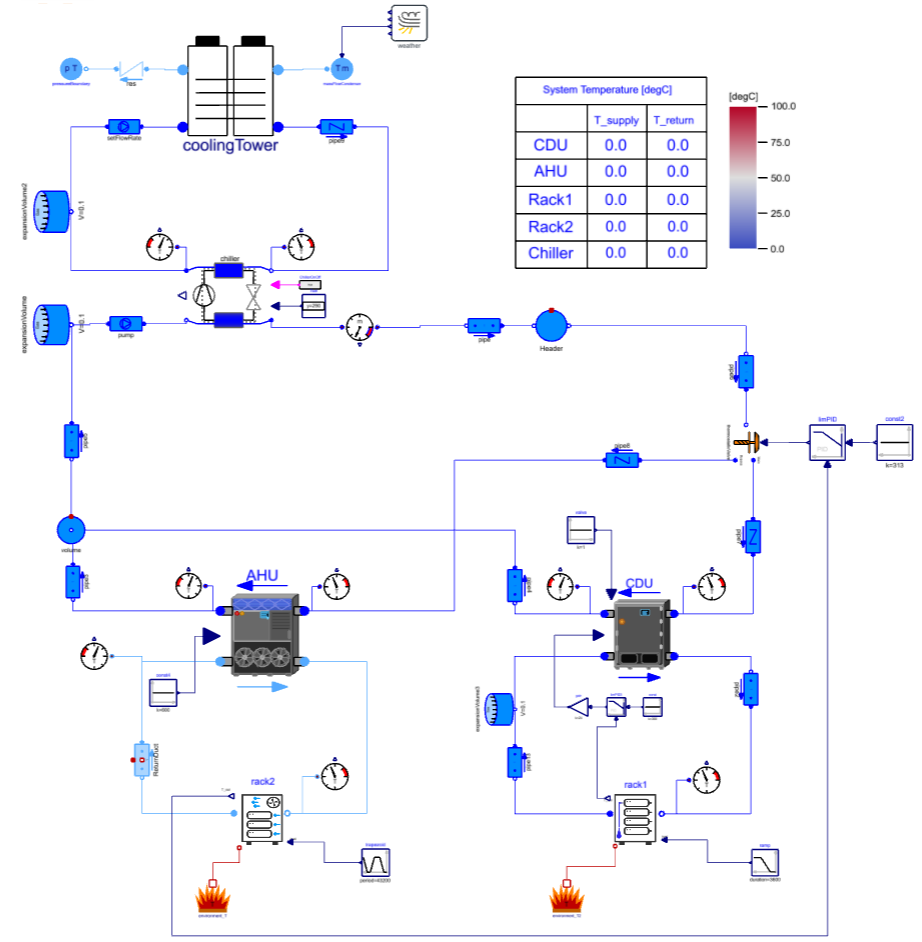
The example demonstrates how empirical performance data can be integrated into a comprehensive data center cooling system model to support design analysis, optimization, and control strategy evaluation.
APPLICATION
Data Center Cooling System Design
This library supports end-to-end system design and virtual prototyping for hyperscale, colocation, and enterprise facilities. Components are rapidly assembled to evaluate alternatives, including standard chiller plants, chillers with waterside economizers, multi-chiller configurations, and hybrid rack arrangements. Teams can test different topologies before committing to hardware.
CDU Vendor Evaluation and Procurement Support
Committing to expensive CDU hardware without understanding how it will perform in a specific facility is a key procurement risk. The library’s pre-calibrated vendor records allow engineering teams to simulate exact hardware under actual facility water conditions and compare options side by side before purchase. This approach provides quantitative performance insights that test rigs cannot deliver prior to procurement.
AI Cluster Cooling Optimization
The library includes a reference liquid-cooled AI cluster system model at the 1 MW scale, covering rack-level cold plate models, CDU and chiller loops, and facility-level PUE tracking. The model supports evaluation of supply temperature setpoints, pump sizing, CDU operating ranges, and cooling capacity headroom for GPU-dense workload scenarios.
Control Strategy, Setpoint Optimization, and Sustainability
The library models supervisory plant controls, including chiller staging, waterside economizer mode switching, and CWST-based setpoint logic, within the same environment used for system design. Teams can evaluate free-cooling utilization, energy efficiency, and control behavior under varying IT loads and ambient conditions before deployment or during operational optimization. This provides a quantitative basis for achieving both performance and sustainability goals.
Resources
Modelon Libraries
Related News & Blog

Ready to use Modelon's libraries for powerful system simulation?
Get in touch with us today to see how Modelon’s libraries handle complex modeling and return accurate results.