Building a Validated Digital Twin for Liquid Cooled AI Data Centers
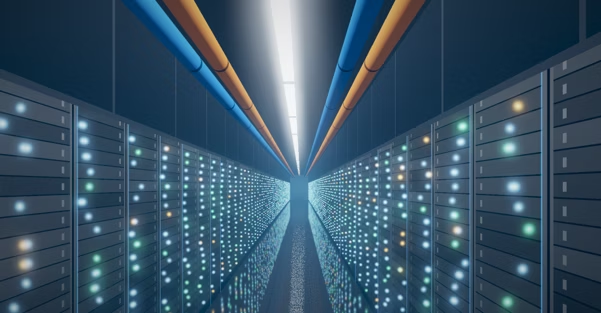

A new joint research project brings industry and academia together to show how liquid cooling for AI data centers really behaves, before anything is built.
COLLINS is a three-year research project building a validated digital twin of the cooling system in a liquid cooled AI data center, from the cold plate on the chip to the heat leaving the building. The aim is to let design and operating decisions be tested against a model calibrated on real equipment under real AI load, before anything is built or changed.
The project runs from September 2026 to August 2029 and is funded in part by Vinnova, Sweden’s innovation agency, with the partners contributing the remainder. The consortium is Modelon as coordinator, RISE, Korea Testing Laboratory, Luleå University of Technology, Vertiv, SWEP and LUVE.
The load moves and the margins are expensive
Rack power keeps climbing. High density GPU racks in operation today draw well past 100 kW, NVIDIA has set out racks of around 600 kW for the second half of 2027 with the Rubin Ultra generation in Kyber racks, and the move to 800 VDC power is being prepared for racks approaching one megawatt. Cooling systems are being specified now for densities nobody has yet operated.
The load also varies over time. Training jobs start and stop, inference demand swings through the day, and a rack can go from idle to full power in seconds. A cooling system that looks efficient at its design point can overshoot, oscillate or run hot when the load changes that fast. A steady state calculation will not say which of those happens.
The response today is margin. Equipment gets oversized, redundancy gets specified generously, and prototypes get built because the assumptions cannot be tested any other way. All of it costs capital, material and energy, and none of it answers what the system does when the workload swings.
Heat rejection gets sized on worst case assumptions, and that margin is paid for in equipment, space and energy. A model validated across the full operating range lets us show what the equipment really does, so the customer can size accordingly. – Stefano Filippini, Technical Director, LUVE
What a validated twin is for
A model of the full cooling chain, calibrated against measurements and run dynamically, answers four questions that matter commercially.
Design comes first. Engineers can compare system topologies and size equipment against the load it will actually see, instead of against a worst case assumption, and find the optimization opportunities while changes are still cheap.
Redundancy is the second. Cooling systems carry spare capacity so that operation continues when a component fails. Running the failure scenarios on the twin establishes how much spare capacity a given reliability target really requires. Every redundant unit that turns out to be unnecessary is capital, floor space and standby energy removed.
A cooling system is built with spare capacity because the failure cases cannot be tested any other way. Running those scenarios on a twin that has been validated against real equipment means we can meet the same reliability target with less hardware in the room. – Peter Van Aken, Global Thermal Practice Lead, Vertiv
Operation is the third. Operators can tune setpoints, pump and fan speeds and control strategies against the workload in front of the facility, and test a control change on the twin before it touches live equipment.
The fourth is the rest of the asset life. The twin gives a baseline that drift and degradation show up against, which supports maintenance planned on condition. It also lets operators evaluate retrofits and heat recovery options on a model that already matches the measured plant.
Calibrated on real hardware, under real AI load
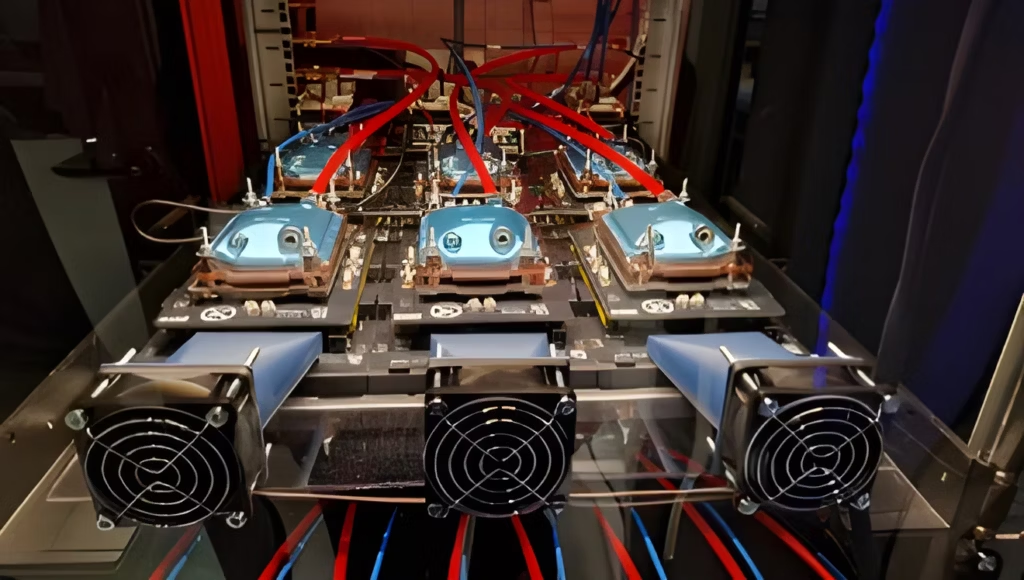
The value of a twin rests on what it has been checked against. COLLINS builds models of the individual cooling components, calibrates them against laboratory measurements, then connects them into system level simulations.
The component models come in with Modelon. The Data Center Library, running on Modelon Impact, already covers the cooling chain from the chip to heat reuse, with cold plates, CDUs, heat exchangers, pumps, valves, piping networks, chillers and cooling towers, across air cooling, single phase and two-phase liquid cooling, and with the controls in the same model. The project work is to calibrate those models against measurements from the test campaigns and to connect them into a system twin.
The hardware comes from the consortium. SWEP, LUVE, and Vertiv contribute products and product knowledge across brazed plate heat exchangers, dry coolers, condensers and CDU technology, covering both single phase and two-phase liquid cooling.
We know how our heat exchangers perform from our own testing. What customers ask now is how that performance holds inside a complete loop while the load is moving. A validated system model lets us answer that, and it brings us into the conversation earlier in the design cycle. – Hans André, Senior Expert Innovation Engineer, SWEP
RISE and Korea Testing Laboratory provide the test facilities, the measurement expertise and the test protocols. RISE server emulators reproduce realistic AI workload profiles on physical equipment, so the models are compared against measured transients, including load steps, as well as against settled operating points. Tuning a control strategy against a steady state model gives a controller that behaves well at steady state. Behavior during the load swings is what decides whether a control strategy works in the facility.
Our emulators let us put realistic AI workloads on physical cooling equipment and measure what happens. That gives the consortium measured transients to calibrate against, which is a harder and more useful test than matching a design point. – Mattias Vesterlund, Research Program Manager, RISE
Test protocols decide whether results from different laboratories can be compared at all. Agreeing them across the consortium is what makes the measurements usable as validation data for the complete system. – Hyo Sung Shin, Principal Researcher and Engineer, Smart Green Technology Center, Korea Testing Laboratory
One model across the lifecycle
The models are built on the open Modelica and FMI standards. Component suppliers can bring models they already have into a dynamic system context without rebuilding them, and the same system model serves a design study and a running plant. Calibration work done once carries forward to the next project.
Modelon contributes Modelon Impact, the physics-based simulation platform the models and system simulations are built on, and coordinates the project. The platform runs in the cloud, so partners in four countries work in one shared workspace on the same version of the models.
We start from a library that already covers the cooling chain from the chip to heat reuse, so the project can put its effort into calibration against measured data. Open standards are what let the partners bring component models they already have into the same system model, and what lets a model built for a design study be used in operation. – Jim Claesson, COLLINS Project Coordinator, Modelon
Public results and what happens first
COLLINS is publicly funded, and the validation methodology, the test protocols and the measured reference cases are planned as public deliverables so that others can reproduce the approach. Luleå University of Technology ties the work to the wider research community.
Data center cooling is still designed largely on static assumptions. Establishing methods in the open that let engineers work from measured system behavior across the life of the asset is how the field moves forward. – Andreas Johansson, Professor, Luleå University of Technology
Year one concentrates on component-level test campaigns and on the calibration workflows that turn measurement data into validated models. System integration and an integrated demonstrator follow.
About COLLINS
COLLINS is a three-year project coordinated by Modelon AB and funded in part by Vinnova under the call Advanced Digitalization. The partners are Modelon, RISE, Korea Testing Laboratory, Luleå University of Technology, Vertiv, SWEP and LUVE. The project runs from September 2026 to August 2029.