From Spec to Simulation: An AI Agent Builds a Data Center Cooling Model
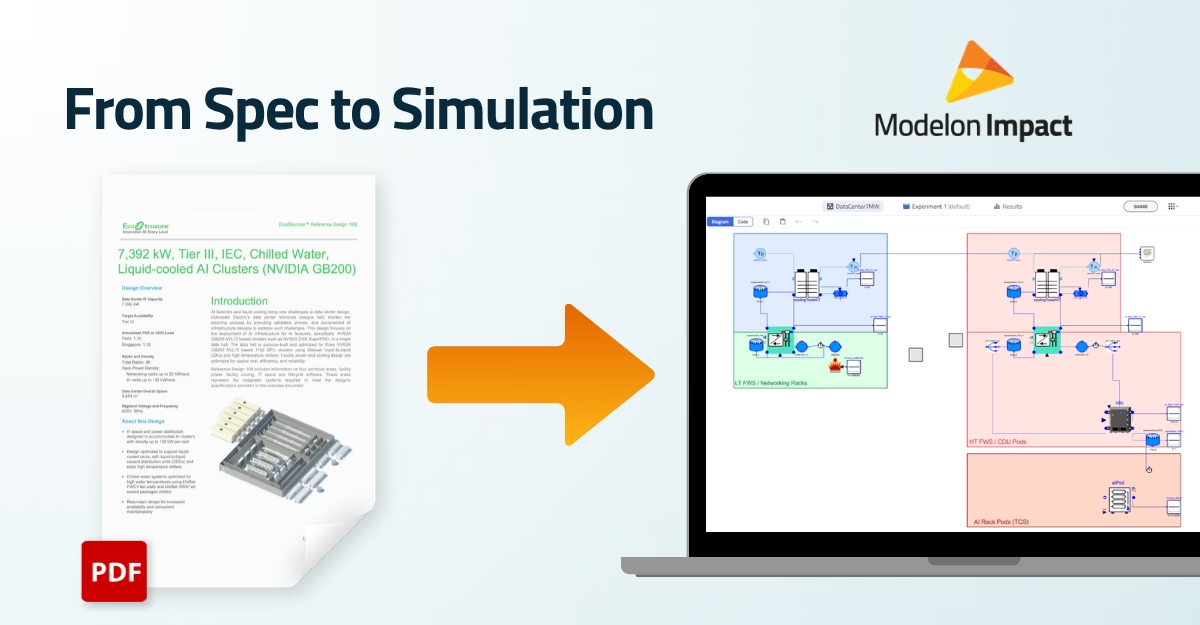

Start from a vendor PDF. End with a validated, simulation-ready Modelica model in a single working session. No manual coding at any step. That is the capability we want to show in this post, and it is a current capability, not a future one.
Data center infrastructure is changing fast. AI compute is pushing facilities toward high-density, liquid-cooled architectures, and direct-to-chip cooling is moving from research into production. Designers have to evaluate more architectures under more time pressure, and the path from a vendor reference design to a model they can actually simulate is slow. Much of that work is systematic: reading specifications, deriving flow rates, selecting components, and wiring them together. That is exactly the kind of work an agent can take on.
The Task: Building a 7.4 MW Dual-Loop Data Center Cooling System
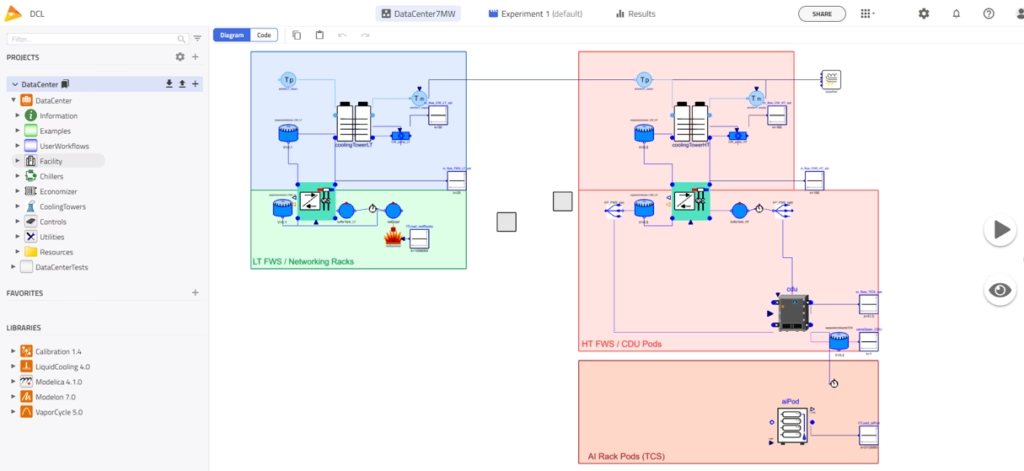
The target is Schneider Electric Reference Design 108 (RD108), a Tier III, 7.4 MW cooling design for NVIDIA GB200 AI racks. It is not a scaled-up version of a smaller plant for which a model already exists. It is a genuinely different topology: a high-temperature loop at 37 °C feeding the AI rack cooling distribution units, and a separate low-temperature loop at 23 °C for the networking racks. Two independent circuits, each with its own chiller, flow rates, and valve sizing.
A topology change is harder than a capacity increase. The agent cannot just scale an existing model. It has to construct new loop boundaries, select independent chiller records for two separate circuits, and derive flow rates and valve sizes for each. And the only input is the RD108 PDF. There is no simulation-ready data in it. Every engineering value has to be derived from the specification and from a validated reference model already in Modelon’s library.
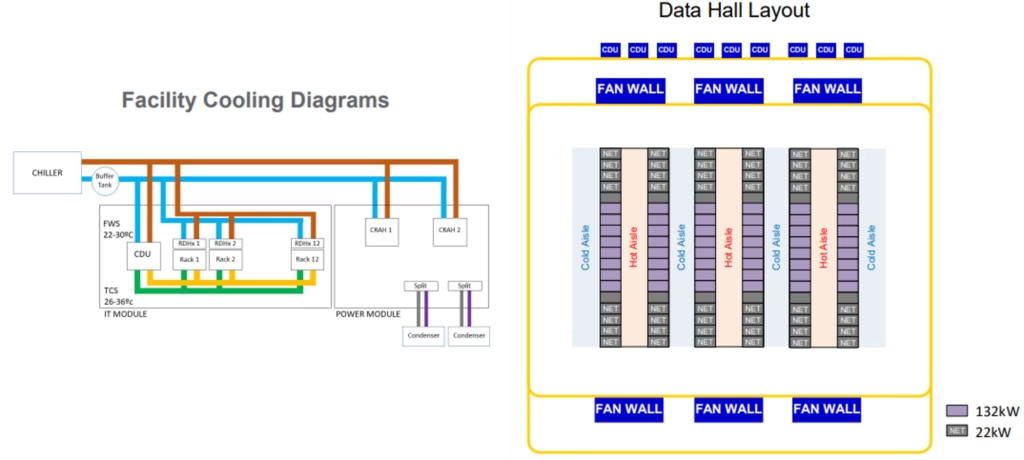
How the AI Agent Automates Data Center Cooling Model Creation
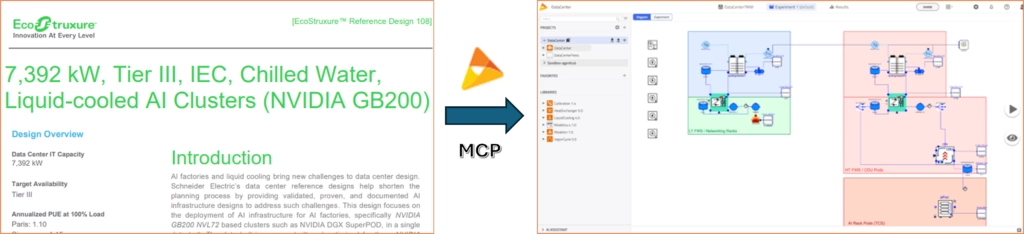
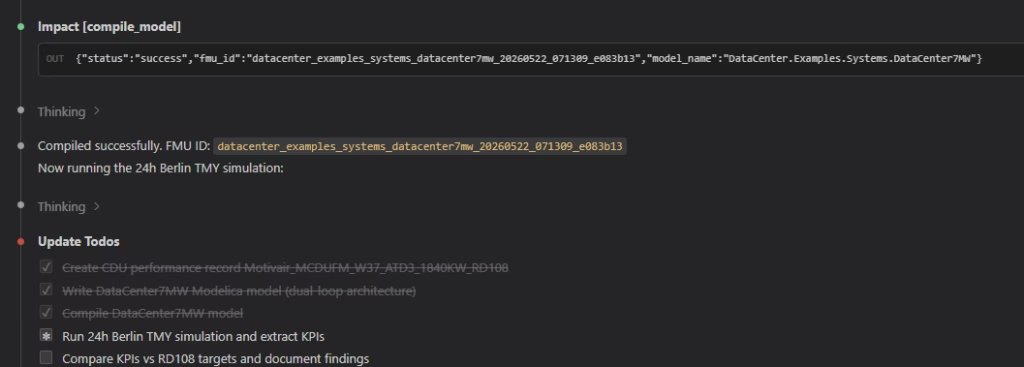
The agent runs on Modelon Impact through a Model Context Protocol (MCP) server. MCP is an open standard for connecting AI agents to external tools, and here it exposes the platform as a set of typed tools: query libraries, read and write Modelica source, compile a model, run a dynamic simulation, and extract results. Every call returns structured data, and the full session is logged and auditable.
The sequence is straightforward. The agent reads the PDF, extracts and tags 27 engineering parameters, and queries the Data Center Library for matching components. Before any code is written, it presents a structured summary of every extracted, calculated, and assumed value, so the engineer can catch a bad assumption before it turns into a failed simulation rather than after. Then it writes 405 lines of Modelica composing the dual-loop topology, compiles on the platform, and launches a 24-hour dynamic simulation.
Why Validated Modelica Libraries Matter for AI-Generated Simulation Models
Here is the part that makes this practical rather than a demo. The agent never wrote a heat-exchanger equation or derived a chiller efficiency curve. It did not need to. The Data Center Library carries vendor-validated component records, including cooling distribution units parameterized directly from manufacturer datasheets, built on Modelon’s Liquid Cooling, Vapor Cycle, and Calibration libraries. Each component carries its own verified physics, established once by domain experts with access to manufacturer data and calibration measurements. Records of this kind are simply not available in community libraries, which is one reason this case study cannot be reproduced with an open-library-only toolchain.
Just as important is what the agent starts from. We did not point it at a blank workspace. We pointed it at Data Center 1MW, a 1 megawatt reference model already validated against Schneider Electric RD48.
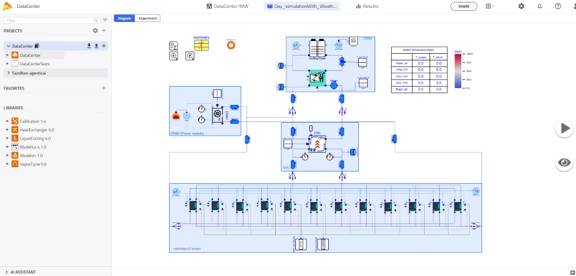
That model encodes conventions the agent can lean on: component patterns, diagram layout, naming, and port wiring. Rather than generating a system from first principles, the agent extends and re-composes a validated reference architecture that already exists in the library.
That is the core idea. The library guarantees the physics; the agent selects and composes. Generating physics from scratch introduces uncertainty that is hard to bound and difficult to audit. Selecting from validated components does not.
The Interesting Part: How the Agent Identified and Fixed a Cooling Model Issue
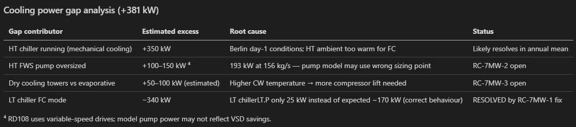
The first simulation is where this gets convincing. Five of six KPIs passed or came close. One did not: the low-temperature loop supply temperature read 42.2 °C against a 23 °C target, a 19 °C miss.
Reading that result back through the tools, the agent traced the loop’s thermal balance, worked out that the networking load plus heat rejection required roughly 1.88 MW of chiller capacity, and found that the chiller record it had instantiated was rated only 1.125 MW, short by a factor of about 1.7. This was not a physics error. The equations were correct. The wrong record had been selected, even though the correct 1,881 kW record had already been identified during the pre-build query.
So the agent re-queried the library, confirmed the right record, swapped it in, removed some now-redundant components, and re-ran the simulation. The corrected run delivered 23.0 °C, exactly on target. The model also got cleaner in the process, from 405 lines down to 366.
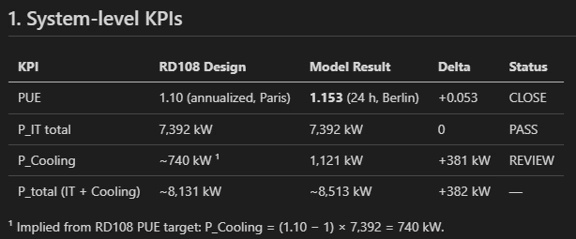
This episode is the reason the validated library matters for correcting models, not just building them. The agent fixed a selection error by re-querying a trusted source of truth. Without that library, there would be nothing to re-query, and you would be left with unverified physics and no calibration history behind it. For infrastructure with asset lifecycles measured in decades, that is not a trade worth making.
Results: From Vendor Specification to Validated Simulation Model in Hours
Specification to validated model in a single session. For comparison, an experienced engineer building the same RD108 model by hand is estimated at three to four working days. The agent completed the full cycle, including the diagnosis and correction, in roughly four hours. Call it six to eight times faster, with every action logged and attributable.
The model is not a sketch or a generated document. It compiles on the platform, runs a 24-hour dynamic simulation, and meets its engineering KPIs against a published reference design.
Where Human Engineering Judgment Still Matters in AI-Driven Modeling
The agent produced a validated draft. It did not replace engineering judgment. A person still decides whether the dual-loop topology is right for the customer, interprets the PUE gap between the Berlin climate used in simulation and the Paris-calibrated RD108 reference, and signs off on Tier III staging decisions that need site-specific knowledge. The right split is to automate the repetitive derivation and assembly work, and to keep human judgment on the decisions that require context the agent does not have.
How This AI Simulation Workflow Scales Across Engineering Domains
The approach works here because four things line up: a validated library exists for the domain, the reference design is specified clearly enough to extract parameters, the KPIs are quantitative and machine-checkable, and the physics fits the equation-based Modelica paradigm. Those are real preconditions, not edge cases, and where they hold the same toolchain applies. Because it is built on open standards throughout, Modelica, FMI, Python, and MCP, the same workflow already runs against thermal management, powertrain, HVAC, and vehicle dynamics libraries inside Modelon Impact. The library content changes between domains. The framework does not.
If an agent can go from a vendor PDF to a validated 7.4 MW cooling model in an afternoon, the question worth asking is, “Which of your own reference designs are waiting for the same treatment?”
References
Schneider Electric. Reference Design 108: 7.4 MW Tier III AI Reference Design (NVIDIA GB200). 2024. https://download.schneider-electric.com/files?p_enDocType=Other+technical+guide&p_File_Name=RD108DSR7-GB200.pdf&p_Doc_Ref=RD108DSR0
Schneider Electric. Modular Data Center AI Reference Design EU — Reference Design 48. 2023. https://download.schneider-electric.com/files?p_enDocType=Other+technical+guide&p_File_Name=Modular+Data+Center+AI+Reference+Design+EU+FINAL.pdf&p_Doc_Ref=RD48DSR0_EN
Anthropic. Model Context Protocol Specification. 2024. https://modelcontextprotocol.io/
Modelon AB. Modelon Impact: cloud-based system simulation platform. https://modelon.com/modelon-impact/