
AI Data Center Cooling
Simulation
Design, simulate, and optimize AI data center cooling systems with confidence, before a single pipe is fabricated. Modelon Impact and it’s new Data Center Library model the full cooling chain—from chiller plant and cooling tower through CDU, CRAH, and cold plate—so engineering teams can compare liquid and hybrid cooling architectures, validate control strategies, and quantify efficiency gains from concept through commissioning. The result: shorter design cycles, lower operational risk, and measurable improvements in energy and water efficiency at scale.
Modelon Impact supports advanced cooling architectures including two-phase cooling with vapor quality tracked against IT load variations at the cold plate, and comparison of mechanical cooling against free cooling. Engineers can evaluate phase-change dynamics, heat exchanger performance, and control strategies together within a single model.


Built for Engineering Teams and Complex Cooling Systems
With Modelon Impact and its validated libraries, simulation engineers, thermal and controls engineers, and data center designers responsible for GPU-dense workloads and AI infrastructure can:
- Accelerate design decisions: compare cooling capacity against IT loads and site-specific weather, identify limiting components, and weigh design alternatives before committing to hardware.
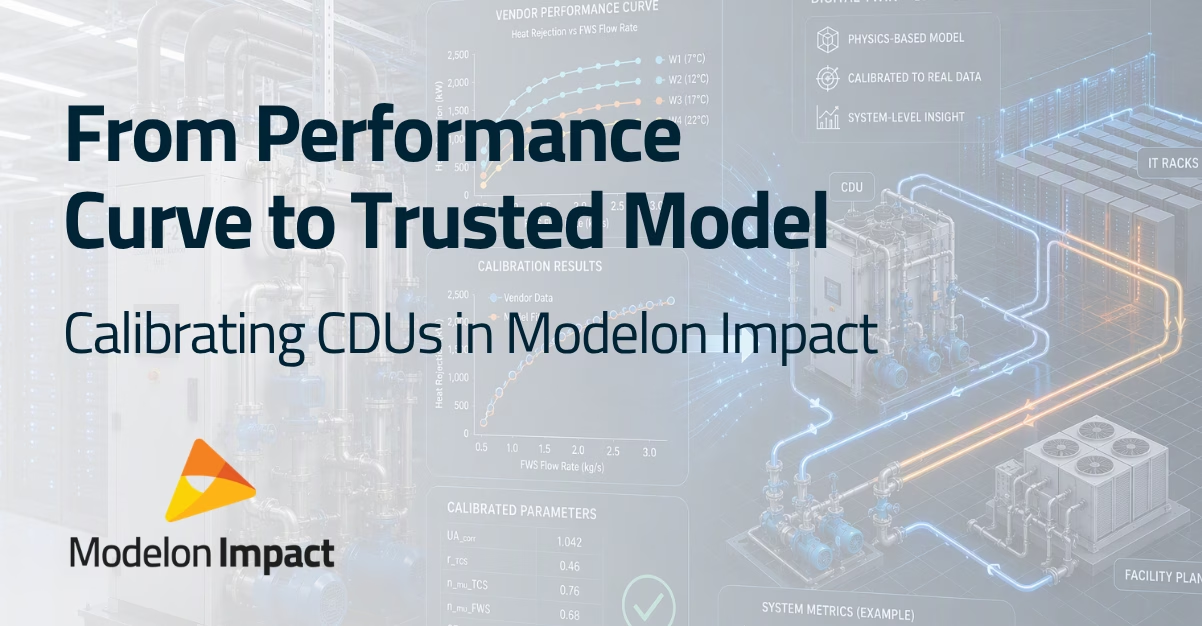
- Compare vendor hardware side by side: use pre-calibrated CDU and CRAH models from leading manufacturers to evaluate liquid, air-cooled, and hybrid options under your operating conditions before procurement.
- Run dynamic, full-system simulations: see how the cooling system responds over time to workload spikes and weather variation—quantifying temperature excursions and control sensitivity to reduce the risk of overheating and throttling.
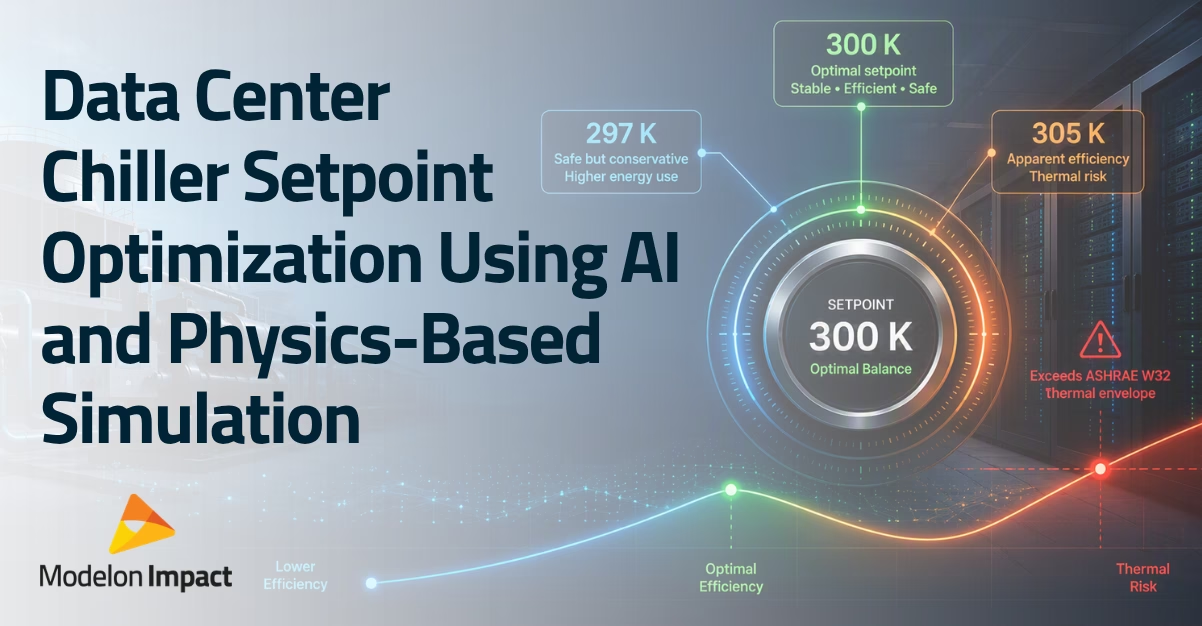
- Optimize energy and water efficiency (PUE/WUE): test staging and control strategies (setpoints, pump/valve behavior, heat-exchanger performance, air–liquid split), quantify tradeoffs and connect results to measurable outcomes for internal targets and stakeholder communication.
- Study two-phase cooling at the component level: use a verified two-phase cold plate and rack model to evaluate vapor quality behavior against IT load variation.
- Design for compliance and operational readiness: align with ASHRAE thermal guidelines and deliver traceable, explainable simulation results engineers and stakeholders can trust.
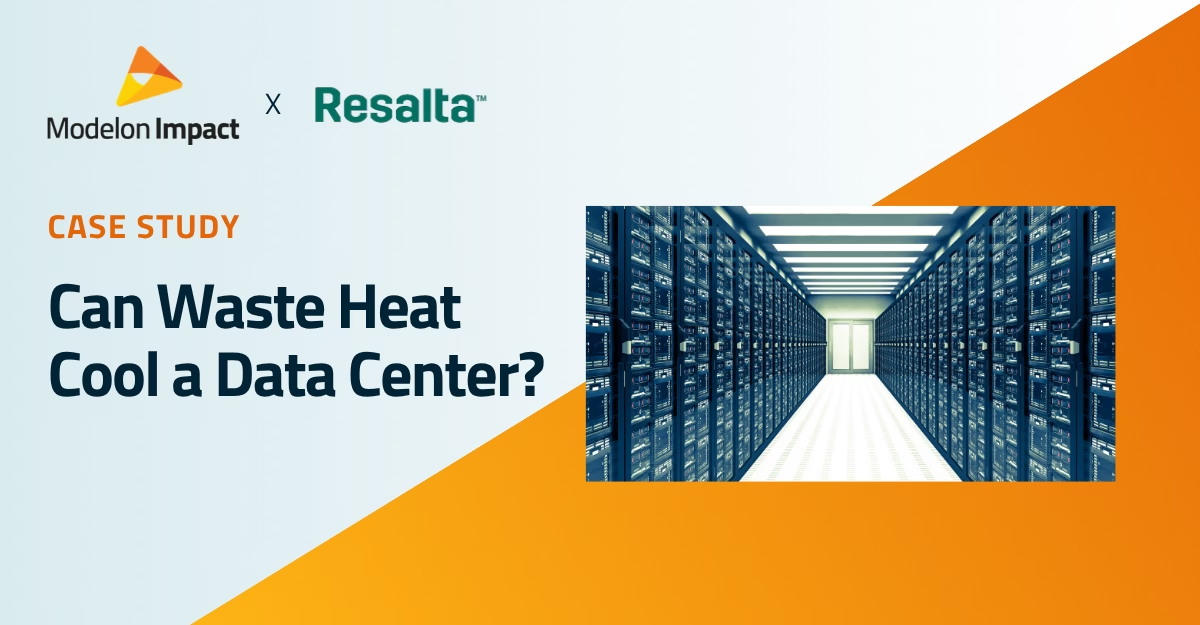
- Explore heat reuse: dive into the Energy Systems Library for dynamic optimization of data center heat reuse and explore its efficiency.
Proven Impact of Virtual Design Optimization
20-50%
Reduction in Development Time
25%
Reduction in Energy Use
$1M
in Risk Avoidance
300x
More Water Efficiency
Shorten development cycles, reduce risk, and improve energy efficiency across the entire cooling ecosystem.
As data centers scale in power density and complexity, liquid cooling becomes a necessity. But managing it efficiently poses new operational risks. Modelon Impact delivers a physics-based system simulation platform purpose-built to optimize liquid and hybrid cooled infrastructures.
A unified, cloud-based multi-physics software platform for 1D system simulation, optimization, and control, Modelon Impact provides:
- Multi-case studies and design-of-experiments via Experiment View
- Live plotting for real-time monitoring of simulation outputs
- Intuitive drag-and-drop modeling canvas that help visualize system layout
- Access to model source code with a modern, AI-enabled text editor for
maximum customization flexibility - Integrations for customized, automated workflows
- Link sharing for quick and easy model deployment
- Model export compliant with the FMI (Functional Mock-up Interface) standard for integration with control design and digital twin platforms
Why Engineering Teams Choose Modelon for Data Center Cooling
Validated libraries. Open standards. Rapid modeling. System-level insight.
From Chip to Facility: What Engineers Can Solve with Modelon Impact
End-to-end liquid cooling systems in a single, open-standard environment.
Modelon provides validated, physics-based component models and complete system templates for designing, testing, and optimizing liquid cooling architectures.
- Model with Accuracy and Speed
- Commission with Confidence
- Operate with Insight
- Reduce Energy and Water Use
- R&D: Plan for Growth and Change
- Accelerate model development with AI-assisted tools
- Leverage high-accuracy, calibrated physics-based models
- Use supplier-certified components from a reusable model library cooling capacity scales with compute load, even as densities rise and cooling
What customers are saying about Modelon
Modelon’s system‑level capabilities allowed us to understand two‑phase direct‑to‑chip cooling in data centers as an integrated system and explore realistic operating conditions with more confidence.
Lingnan Lin, Ph.D.
Department of Mechanical Engineering, University of Maryland

If we get stuck, it’s refreshing to be able to directly reach out to the developers of the technology to get the support and direction that we can trust. This level of support helps us make quicker decisions in our product development cycle.
Arne Knoblauch
Chief Technology Officer, 1W1 GmbH

Working with Modelon not only enhances our confidence in the design’s overall performance, but also enables us to identify and address potential issues related to startup, stop, and trip events.
David Danesi
Project Manager & Technical Proposal Leader, Turboden

Modelon reviewed our requirement and developed a model with uninterrupted communications through bi-weekly online meetings with project updates. Modelon Impact was the right choice.
Dr. Koji Moriyama
Principal Engineer, American Honda Motor Company, Inc.

We selected Modelon Impact because the platform has many aspects that set it apart from other tools in the market including its Modelica-based language, physics-based modeling capabilities, and quick support team.
Koji Matsushita
Kyocera Corporation

Using a system modeling tool like Modelon offers a means to generate the results we want and provide them to our members in a quick and accurate way.
Jim Harper
Principal Technical Lead, EPRI

Modelon’s libraries are giving us more confidence in our early system designs and enable us to build and run simulations more quickly than ever before.
Kruno Hrvatinić
Head of Control and Simulation, Rimac

Modelon stood out with its reliable simulation capabilities, offering comprehensive component libraries that helped us analyze the behavior of air conditioning systems before prototyping.
Jun Young Choi
CAE Engineer, Hanon Systems

Working with Modelon Impact has been a seamless process. I easily followed the instructions, logged in, and simulated the heat pump model without any problems.
Anna Sjunesson
Dynamic Simulation Expert, Siements Energy

Related Blogs and Resources

New eBook! From Equipment to Ecosystem: Embracing System-Level Simulation for Data Center Projects
System Simulation Applications for Data Center Liquid Cooling
Liquid cooling systems are complex, interconnected ecosystems where thermal, hydraulic, and control decisions directly impact performance and uptime. System simulation enables engineers to evaluate these interactions holistically reducing risk and accelerating confident design decisions.
Coolant Distribution Units (CDUs)
- Primary/secondary cooling loops
- Plate heat exchangers for single phase and two-phase cooling
- Pump staging and variable-speed control
- Valve actuation and bypass configurations
Rack & Server Cooling Loops
- Flow balancing and flow network behavior
- Temperature and pressure gradients across racks
- User-defined transient thermal load Microchannel cold plates
- Condenser, receiver, flow restrictions for pumped two-phase cooling
Control Systems
- Supervisory control strategies for chiller and free-cooling economizer
- Pump speed and sequencing control
- Valve position optimization
- Temperature and pressure regulationSensor noise
Facility-Level Cooling Systems
- Chilled-water loops
- Heat exchangers, dry coolers, cooling towers
- Free cooling and hybrid cooling integration
- Heat recovery / district heating
- Failure simulations
Modeling Resources for Data Center Cooling
Modelon’s Validated Simulation Libraries
Start Building Better Cooling Systems Today
Whether you’re scaling AI compute infrastructure, transitioning from air to liquid cooling, or designing and selling innovative liquid cooling technologies, Modelon accelerates your design process and strengthens engineering confidence.