
Resalta Models an 81% Reduction in Data Center Cooling Electricity with Modelon Impact

Resalta used system simulation to evaluate waste heat recovery for next-generation data centers.
Background
As demand for high-performance, energy-efficient data centers continues to grow, operators face increasing pressure to reduce energy consumption, lower emissions, and maintain reliable cooling under all operating conditions.
Resalta, a European energy services company, designs, builds, and operates integrated energy solutions for industrial customers and critical infrastructure. To improve efficiency and maximize energy utilization, engineers explored an innovative concept that combines onsite power generation with advanced cooling technologies.
The concept uses waste heat from a gas turbine to drive an absorption chiller, providing cooling for data center operations while reducing reliance on conventional electrically driven cooling systems. Before advancing the concept, they needed to understand how the integrated energy system would perform under real-world operating conditions throughout an entire year..
Challenge
Resalta set out to evaluate the annual performance of a complex energy system designed to provide both power and cooling for a data center operating in island mode. Reliability, redundancy, and performance under changing operating conditions were critical considerations.
The team needed to assess how the system would perform as ambient temperatures and data center loads varied throughout the year, while monitoring key operating parameters including cooling performance, component efficiencies, operating temperatures, flue gas composition, and overall system efficiency.
Initially, the team explored spreadsheet-based analysis. However, the growing complexity of the system, including a gas turbine, absorption chiller, dry cooler, heat rejection equipment, and auxiliary systems, made it increasingly difficult to evaluate scenarios and understand interactions between components.
Jan Škruba,
Project Engineer, ResaltaResalta needed a modeling approach capable of accurately representing the behavior of the complete energy system while enabling rapid evaluation of multiple operating scenarios and design alternatives.
Solution
Resalta selected Modelon Impact to build a dynamic simulation model of the integrated power and cooling system. Rather than analyzing individual equipment in isolation, the team created a connected system-level model that captured interactions across the entire energy chain.
Using Modelon Impact, Resalta developed performance models for key equipment that could represent operation under varying load factors and ambient conditions. These models were then integrated into a full-system simulation capable of evaluating operation across an entire year.
The model represented:
- A gas turbine producing onsite power
- Gas turbine exhaust at 490°C driving an absorption chiller
- Chilled-water delivery to the data center at 22°C
- Heat rejection through a dry cooler operating at 40-45°C
- A backup electric heat pump to maintain cooling during startup and maintenance periods
Unlike spreadsheets, Modelon Impact enabled dynamic simulation of transient behavior. Resalta could analyze equipment startups and shutdowns, changing cooling demands, control system interactions, and operating transitions that were not practical to represent using steady-state calculations alone.
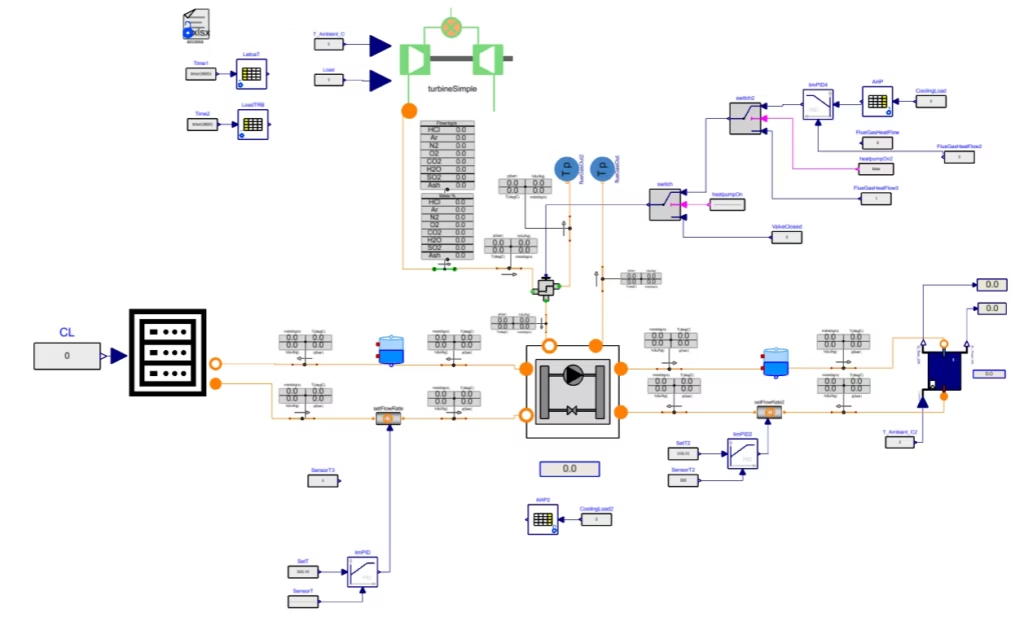
The component-based approach also enabled engineers to modify equipment performance maps, operating assumptions, and control strategies without rebuilding the entire model, making it significantly easier to evaluate alternative system configurations.
Jan Škruba
Project Engineer, ResaltaResults
By leveraging Modelon Impact, Resalta successfully evaluated the performance of its integrated gas turbine and absorption-chiller concept across a full range of operating conditions and seasonal variations. The simulations provided valuable insight into annual energy performance while helping identify areas requiring further attention during system development.
Quantifying the Value of Waste Heat Recovery
The results demonstrated that utilizing gas turbine exhaust heat to drive cooling can dramatically reduce reliance on conventional electrically driven cooling systems. The modeled system delivers about 52 GWh of cooling annually. A conventional compressor chiller with an energy efficiency ratio (EER) of 3.3 would require approximately 15.7 GWh of electricity to provide the same cooling output. In comparison, the absorption-cooling system requires only 3.02 GWh of electricity for auxiliary equipment, representing an estimated 81% reduction in cooling-related electricity consumption.
The analysis also showed about 12.7 GWh of annual electricity savings compared with conventional compressor-based cooling by using recovered waste heat as the primary energy source for cooling production.
Improving Overall Data Center Efficiency
The integrated system provides both electrical power and cooling from a common fuel source. Based on a modeled data center electrical load of 5.09 MW, total electrical generation of 5.45 MW, and auxiliary consumption of 0.36 MW, the system achieved a modeled Power Usage Effectiveness (PUE) of about 1.1.
The model also demonstrated strong overall energy utilization. The system produces 46.3 GWh of electricity and 52 GWh of cooling annually from 174 GWh of natural gas input, resulting in an overall useful-energy utilization of about 56.6%.
Accelerating Engineering Analysis
In addition to validating system performance, Modelon significantly improved engineering efficiency. For the initial system model, Resalta reduced model preparation and scenario evaluation time from approximately one month to one week, representing roughly a 75% reduction in engineering effort. Once the model was established, engineers could quickly evaluate different equipment selections, operating strategies, and boundary conditions without manually rebuilding interconnected spreadsheet calculations.
Jan Škruba
Project Engineer, Resalta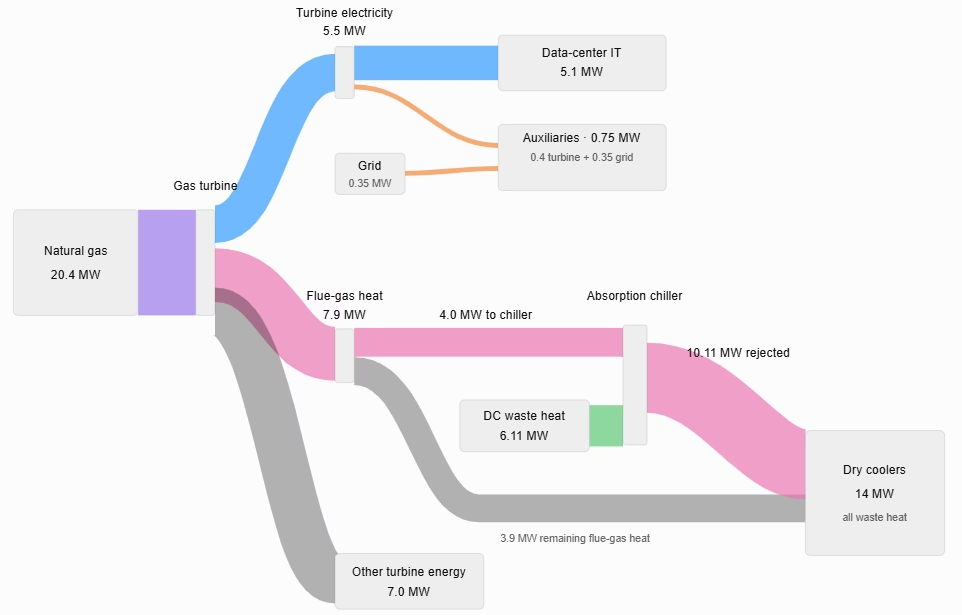
The energy-flow analysis clearly illustrates how recovered turbine exhaust heat contributes to cooling production while improving overall system efficiency. The visualization also helped Resalta communicate performance benefits to both technical and commercial stakeholders.
Business Impact
Beyond providing technical validation, Modelon Impact became a valuable decision-support and communication tool. By replacing fragmented spreadsheet calculations with a dynamic, system-level model, Resalta gained the ability to evaluate customer-specific operating conditions, compare alternative system architectures, and communicate expected performance using credible, physics-based results. Engineers could identify integration and control issues earlier in the development process, when changes were still relatively quick and inexpensive to implement. As a result, Resalta can move from concept evaluation to customer-ready analysis more efficiently, with greater confidence in both the technical performance of the solution and the recommendations provided to customers.
Key Results at a Glance
- 81% reduction in cooling-related electricity consumption
- 12.723 GWh annual electricity savings compared with conventional compressor cooling
- Power Usage Effectiveness (PUE) of 1.1
- 56.6% overall useful-energy utilization from a combined power-and-cooling architecture
- 75% reduction in model preparation and scenario-evaluation time