Introducing the Data Center Library for Modelon Impact

See how reference system designs and calibrated vendor components help data center teams move faster and engineer with greater confidence.
As AI workloads drive unprecedented increases in rack density, power consumption, and thermal complexity, data center teams are under pressure to evaluate new cooling technologies, reduce risk, and deliver infrastructure faster than ever before.
Today, Modelon is introducing the Data Center Library, a new solution available exclusively in Modelon Impact that helps engineers design, simulate, and optimize complete data center cooling systems—from cooling plant to rack.
Built for hyperscalers, colocation providers, engineering firms, and cooling equipment manufacturers, the Data Center Library provides configurable models, supervisory controls, calibrated vendor equipment models, and reference architectures that help teams make better, faster decisions earlier in the design process while creating a path toward operational optimization and digital twins.

Why Data Center Cooling Has Become More Complex
Traditional data center cooling approaches were developed for relatively predictable compute loads and lower rack densities. AI infrastructure is changing the equation.
Today’s engineering teams must evaluate increasingly complex questions:
- Should we use air, liquid, hybrid, or two-phase cooling?
- How will cooling plants perform under changing AI workloads?
- What are the energy and water tradeoffs between design alternatives?
- How will supervisory control strategies impact efficiency and resilience?
- How can we validate decisions before equipment is ordered or deployed?
Too often, these decisions rely on spreadsheets, isolated subsystem tools, or late-stage testing that provide limited insight into how the complete cooling system performs as one connected system. The Data Center Library was built to close that gap.
A System-Level Approach to Data Center Cooling
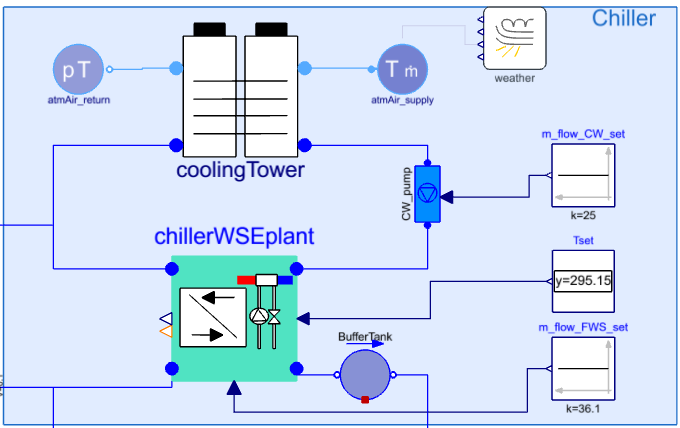
The Data Center Library enables teams to model and evaluate cooling systems across thermal, hydraulic, and control domains in a single simulation environment.
Rather than analyzing individual components in isolation, engineers can understand how facility-side infrastructure, distribution systems, rack-level cooling, and controls interact under realistic operating conditions.
The library includes:
- Cooling plant models
- Distribution systems
- Coolant Distribution Units (CDUs)
- In-row CDUs
- Computer Room Air Handlers (CRAHs)
- Chillers and cooling towers
- Pumps and heat exchangers
- Air-, liquid-, and hybrid-cooled rack models
- Supervisory control systems
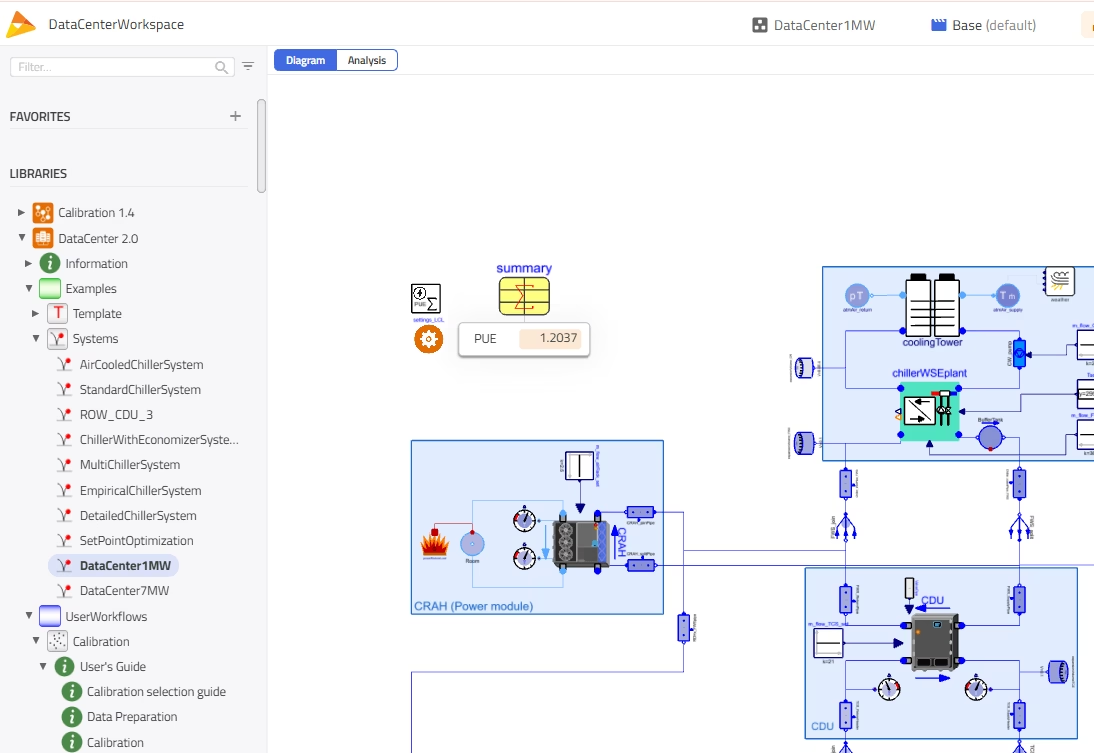
- PUE monitoring capabilities
- Reference system architectures
The result is a more complete view of system behavior before physical deployment.
Evaluate Cooling Architectures Earlier
Whether designing a new AI data center or evaluating technology upgrades, teams can compare alternative cooling strategies before committing capital.
Using the Data Center Library, engineers can:
- Compare air, liquid, hybrid, and two-phase cooling approaches
- Evaluate facility and rack-side design tradeoffs
- Optimize operating setpoints
- Assess energy and water consumption
- Study transient behavior under varying loads and environmental conditions
- Validate control strategies before commissioning
By shifting evaluation earlier in the process, organizations can reduce costly redesigns, avoid overbuilding infrastructure, and improve confidence in key investment decisions.
Lingnan Lin, Ph.D.
Department of Mechanical Engineering, University of MarylandAccelerate Engineering Studies with Reusable Models & Reference Designs
Engineering teams are often forced to rebuild analyses from scratch across projects, spending valuable time assembling models before meaningful evaluation can begin. The Data Center Library helps standardize and accelerate workflows through reusable components, configurable architectures, and built-in engineering knowledge.
Teams can leverage:
- Pre-configured reference designs
- Reusable workflows and configurable system templates
- Vendor-calibrated equipment models
- ASHRAE W1–W4 temperature class coverage
- Integrated supervisory control examples
This allows engineers to spend less time assembling models and more time evaluating design alternatives and optimizing performance.
Improve Energy and Water Efficiency
As power demands continue to rise, reducing resource consumption has become a business imperative. The Data Center Library enables engineers to evaluate how operating setpoints, control logic, cooling configurations, and environmental conditions influence:
- Power Usage Effectiveness (PUE)
- Water Usage Effectiveness (WUE)
- Cooling plant performance
- Free-cooling utilization
- Total cost of ownership
By understanding these interactions at the system level, organizations can identify efficiency improvements that may be difficult to uncover with traditional analysis methods.
From Design Simulation to Digital Twin Foundations
The value of simulation does not end at commissioning. The same physics-based models used during design can serve as the foundation for future digital twin initiatives. By combining system models with operational data, organizations can gain deeper insight into facility performance, evaluate changes before implementation, and continuously optimize cooling operations as workloads evolve. This creates a natural pathway from design validation to long-term operational excellence.
Built for AI-Ready Engineering Workflows
Available exclusively in Modelon Impact, the Data Center Library benefits from Modelon’s cloud-native simulation environment and AI-assisted engineering capabilities. Distributed teams can collaborate in a shared workspace, scale simulation studies, and accelerate model development using AI-assisted workflows designed to improve productivity across both design and operational use cases.
A New Foundation for Data Center Cooling Innovation
As the industry moves toward higher-density computing, advanced liquid cooling technologies, and increasingly complex infrastructure, engineering teams need more than component-level analysis. They need a system-level understanding of how the entire cooling chain behaves.
The Data Center Library brings together configurable components, reference architectures, supervisory controls, and reusable workflows in a single simulation environment, helping organizations design better cooling systems, improve efficiency, reduce risk, and prepare for the next generation of AI infrastructure.
Ready to see the Data Center Library in action? Schedule a demo and learn how system-level simulation can help accelerate your next data center project.