Where Data Center Cooling Is Heading: Key Learnings from ASME SHTC 2026

At ASME SHTC 2026, researchers and industry leaders discussed the future of data center cooling, thermal management, and AI infrastructure. Here are a few observations from the conference, including liquid cooling, two-phase technologies, heat reuse, and the growing importance of system-level modeling.
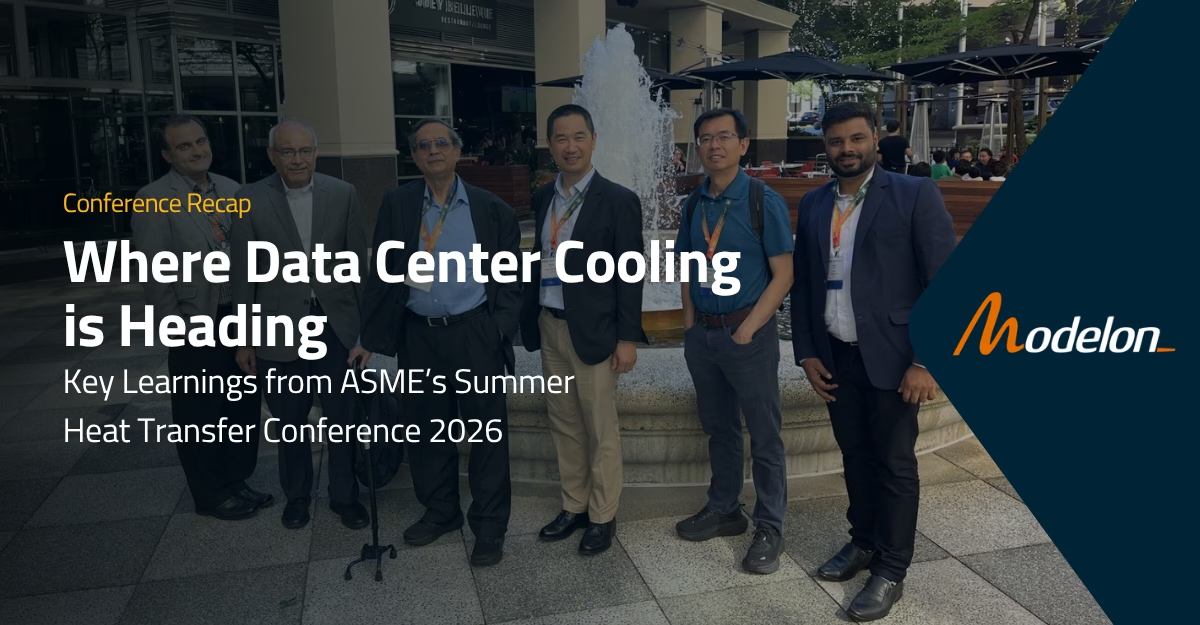
I was in Bellevue, Washington this July for the American Society of Mechanical Engineers (ASME) Summer Heat Transfer Conference (SHTC), where I participated on a panel about data center and semiconductor thermal management. It was my first time attending the conference and I traveled with my colleague, Matt Brisbois from Modelon. Between the two of us, we came back with a lot to think about. A few things stuck with me, so I wanted to share.
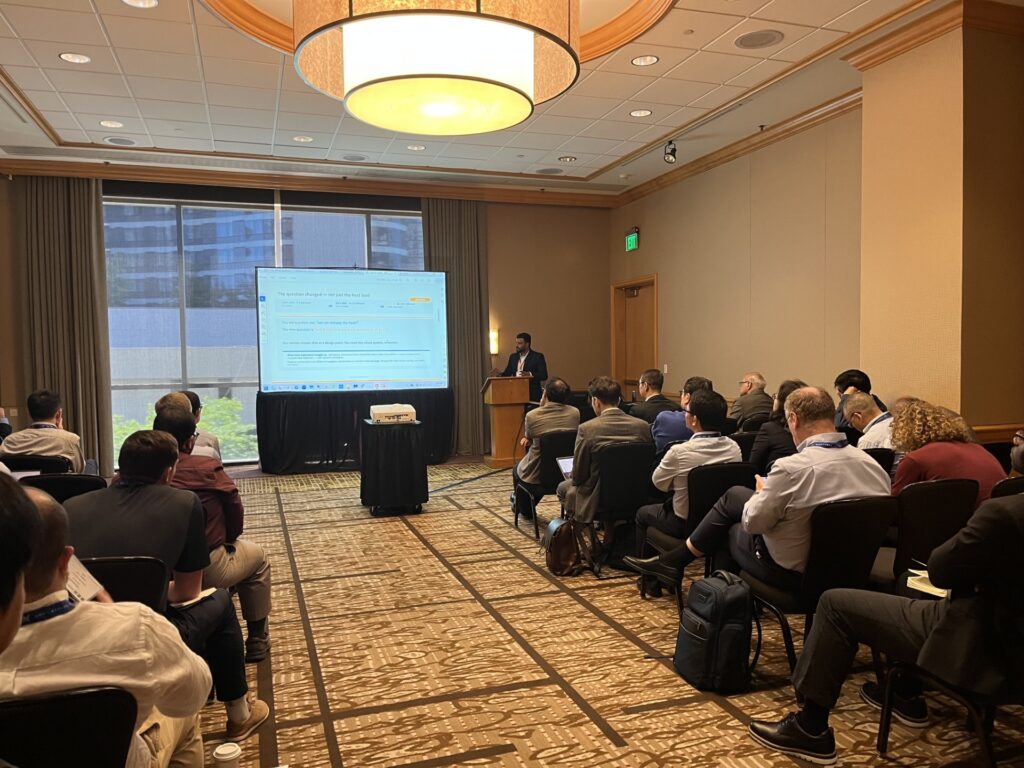
It was a full room.
The conference is more academic than I expected. Most attendees are doing deep research on the fundamentals of heat transfer and fluid mechanics. As a result, the data center sessions felt a little different from the rest. Our panel session drew more than eighty people, and the plenary talks from Microsoft and Google made it clear why the topic is attracting that level of interest.
The panel itself brought together a strong mix of academic and industry perspectives. It was chaired by Prof. Amitabh Narain (Michigan Tech), with fellow panelists Yogendra Joshi (Georgia Tech), Wangda Zuo (Penn State), Qingyang Wang (Accelsius), Tony Lin (AMD), and Navid Gougol (Yektasonics). Being one of the industry voices in a predominantly academic room turned out to be a good place to sit. People were genuinely curious about what is happening in practice.
Liquid cooling is settled. Now, it’s about efficiency.
If there was one thing everyone seemed to agree on, it was that liquid cooling is where the industry is heading. That part of the debate is more or less over. What people are focused on now is efficiency. Power usage effectiveness (PUE) still matters, and water usage effectiveness (WUE) came up repeatedly as water becomes a resource that needs to be actively managed.
One detail I had not fully appreciated before is that a single row of racks is no longer thermally uniform. It may contain AI GPUs, CPUs, and networking servers side by side, each with different cooling requirements and operating temperatures.
There is significant research underway on how to distribute coolant across these mixed workloads and how to adapt cooling strategies as those workloads change over time.
The new ideas are interesting, but they’re not unblocked.
Several emerging directions received a lot of attention:
- Running chips at higher temperatures, above 45°C, which changes the requirements for heat rejection.
- Two-phase cold plates, which several teams are actively investigating in the lab.
- Cold underground thermal energy storage (Cold UTES), which uses the ground itself to store and reject heat.
What struck me was that the hard part is often not the technology itself. Infrastructure limitations and government policy came up again and again as the factors actually holding some of these ideas back.
Heat reuse is becoming a major topic.
Some of the liveliest discussions centered on what to do with the heat that data centers reject. There is considerable interest in recovering that energy through district heating, carbon capture, and direct air capture.
None of these approaches is easy. Still, the appetite for making data centers part of the broader energy ecosystem, rather than simply a consumer of energy, was hard to miss.
The challenge underneath it all: variable AI workloads.
If I had to name the one challenge running through every one of these conversations, it would be the load. A data center is designed for a certain capacity, but its actual operating conditions are nowhere near constant.
AI workloads rise and fall, and the cooling system has to respond across widely varying conditions. Build for a peak that rarely arrives, and you waste money and energy. Build for the average, and you risk being caught out when demand spikes. That gap between how a system is designed and how it actually operates is where efficiency is won or lost.
This is also the part closest to what I do. When the chip, the cooling loop, and the facility are all responding to a load that never sits still, it becomes difficult to understand the whole picture by studying each component in isolation. Modelling the entire cooling chain as a single system is one way to address that challenge and make decisions with greater confidence before anything is built. That was the perspective I shared on the panel, and it seemed to resonate with the room.
What stayed with me …
What I will remember most is that this is a field with a great deal of momentum right now. Research groups are pushing hard on the fundamentals, major operators are clearly moving with urgency, and the space between them remains wide open. It is a good time to be working on this problem.
Thanks to Prof. Amitabh Narain for the invitation and for leading a lively session, and to Matt for the good company throughout the trip. It was a rewarding week.
Read our exclusive, in-depth pre-conference interview with Prof. Narain on the challenges facing data center cooling today.
View slides from my presentation at SHTC 2026.
Nithish Selvan is a Senior Simulation Engineer at Modelon working on system simulation for data center thermal management.