Why CFD is the Wrong Tool for the Next Generation of Liquid-Cooled AI Data Centers

Computational Fluid Dynamics (CFD) has been the workhorse of data center thermal design for two decades. For the AI data centers now coming online, it is the wrong tool. That is not an indictment of CFD; it remains a powerful, mature technology. It is a consequence of how radically the cooling problem has changed.
The machines we are now asked to cool do not behave like the air-cooled halls CFD was built to model. To understand why a different class of engineering tool is needed, start with the heat.
The Cooling Challenge Has Fundamentally Changed
In a conventional data center, heat is evacuated by moving a large mass of air. The thermal load is spread across a room, fans push cool air through the floor, and CFD does an excellent job of predicting how that air circulates around racks and aisles. The problem is diffuse, relatively steady, and well suited to a spatial flow model.
AI workloads break this model. The heat generated by modern GPUs is extremely localized and concentrated in a handful of components drawing power densities that air simply cannot carry away. Worse, it is unpredictable: depending on the workload, it is impossible to know in advance precisely where and when the heat will spike. A room-scale air model has nothing useful to say about a transient hot spot inside a server.
The answer the industry has converged on is liquid. High cooling power must be delivered directly to the source of the heat, through cold plates and liquid loops that pull thermal energy out where it is generated rather than diluting it across a hall of air. This is a different physical regime, and it demands a different way of engineering the system.
The numbers make the shift concrete. A conventional air-cooled rack draws perhaps 5 to 15 kW; the latest GPU racks are specified well beyond 100 kW, with vendor roadmaps pointing higher still. At those densities, the heat flux at the chip surface simply exceeds what air can remove at any realistic flow rate. And the load is not merely dense but volatile: large training runs can swing the power draw of an entire hall in seconds as thousands of GPUs synchronize, pause at checkpoints, and resume. The industry has responded in kind: ASHRAE now publishes dedicated liquid-cooling guidance, and the Open Compute Project has made cold-plate and coolant-distribution standards a central workstream. Liquid is no longer a niche option; it is the design basis of the next generation of facilities.
Why Dynamic System Simulation Is the Right Tool
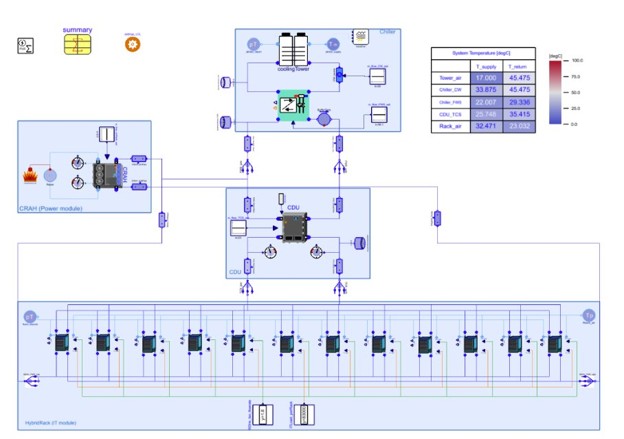
So what is system simulation, and why does liquid cooling call for it? A liquid cooling installation is, at heart, a network: pumps, valves, cold plates, heat exchangers, and pipe runs connected in closed loops, far closer in character to a process plant or an automotive thermal-management system than to an open hall of circulating air. System simulation is the tool built for exactly this kind of network. Rather than resolving the flow field in three-dimensional detail, it captures the underlying physics (conservation of mass, energy, and momentum, combined with empirical relations for each component) and discretizes the system along the direction of fluid flow, typically in one dimension. For liquid, that one dimension is the natural one: coolant in a pipe goes where the pipe goes, so the network topology itself is the model. The result is a representation of the whole cooling system and its behavior over time, at a fraction of the computational cost of a full CFD solution. It is no coincidence that the industries that embraced liquid thermal management decades ago (automotive, aerospace, power generation) are precisely the ones where system simulation became standard engineering practice.
Building such a model is a matter of connecting validated components (each pump, valve, cold plate, and heat exchanger represented with physically meaningful parameters) rather than meshing geometry, so a model of a coolant distribution unit serving dozens of racks comes together in days, not months. The payoff is speed: a transient that would take a CFD solver days to resolve can be simulated in minutes, fast enough to sweep hundreds of design variants, run a full year of operation against historical weather data, or test how the system rides through a pump failure, a stuck valve, or a sudden load step. Those failure and transient scenarios are precisely the ones that size the buffer tanks, set the pump redundancy, and define the control margins, and while transient CFD can resolve any one of them in isolation, no project budget can afford to explore them exhaustively that way.
Because the heat is transient and the cooling must respond in real time, timely delivery of cooling capacity is the central design problem. That is fundamentally a dynamic question (how the system behaves over time, under changing load), and it is exactly what dynamic system simulation is built to answer. CFD can, of course, run transient analyses too; the issue is not capability but cost. Resolving even seconds of physical time across a full cooling network is computationally prohibitive, which is why transient CFD stays confined to component-level studies while the system-level questions go unanswered. Beyond making the time domain tractable at system scale, system simulation brings three decisive advantages:
- Integration of the full thermal path. It connects the technical cooling loop to the facility loop—all the way to the chiller plants—enabling a more integrated, holistically optimized design rather than a chain of separately tuned components.
- Integration of controls. The setpoints governing the system are what ultimately define overall data center efficiency. System simulation lets you design and test that control strategy as part of the model, not as an afterthought.
- Real-time capability. System models run far closer to real time than CFD ever could, making them suitable as the foundation for digital twins—including live integration with platforms such as NVIDIA Omniverse.
CFD Still Has a Place
None of this means CFD disappears. Hybrid air-and-liquid systems are still dominant in the installed base and in much of what is being built today, and CFD continues to play an important role wherever air-side flow matters. Even as system simulation increasingly captures hybrid data center behavior at a useful level of abstraction, there are problems where resolving the flow field in detail is exactly what you need.
Cold-plate design is the clearest example. Getting coolant to flow evenly across a plate, minimizing pressure drop, and eliminating local hot spots is a detailed fluid-dynamics problem, and CFD remains a key technology for it. The point is not that CFD is obsolete; it is that CFD alone can no longer design the system.
The two approaches are also complementary in a more direct sense: detailed CFD studies of a cold plate or a heat exchanger can be reduced to characterized performance maps that feed the system model, carrying the fidelity of the component analysis into the whole-system simulation. Used this way, CFD and system simulation form a toolchain rather than a rivalry, each operating at the scale where it is strongest.
Finding the Synergies
In the end, this is about finding the synergies. Dynamic system simulation is not a replacement for every tool in the data center engineer’s kit; it is a key addition to it, the one that finally puts the time-domain, whole-system behavior of liquid cooling within reach.
For engineering organizations, the practical question is one of sequencing: which projects to pilot first, how to connect system models to existing CFD and CAD workflows, and how to build the in-house competence to own the models across a facility’s lifetime. The encouraging news is that the transition is incremental. A system model of a single technical cooling loop already pays for itself in design insight, and it can grow outward from there, toward the facility loop, the controls, and ultimately a live digital twin of the operating data center.
Modelon is helping hyperscalers, AECs, and component manufacturers update their toolchains for exactly this transition, bringing system simulation alongside the tools they already trust, so the next generation of liquid-cooled AI data centers can be designed for the way they actually behave.
The liquid revolution in AI data center cooling is already underway. The only question is: is your toolchain ready to take full advantage of it?
Explore Modelon’s Data Center Liquid Cooling Solutions.