Physics for Every Engineer: Key Takeaways from Modelon’s Capital Markets Day 2026

For decades, system simulation has been one of engineering’s most powerful tools, and one of its most exclusive. The software was sophisticated, the learning curve was steep, and the people who could run it well were few. Design decisions that depended on simulation often waited days, weeks, or months for an expert to become available.
At Modelon’s Capital Markets Day in Stockholm last week, the leadership team laid out how that is changing. The short version: AI agents built into Modelon Impact are opening validated, physics-based simulation to every engineer, not just the specialists. And because those agents work on top of models proven with customers for more than two decades, faster and easier does not mean less trustworthy. Here are the takeaways that matter most for engineering teams.
1. Simulation is no longer reserved for experts
CEO Jan Häglund opened with a candid admission. Despite his own background in physics, he found Modelon Impact challenging to learn, while Modelon’s experts had spent years mastering it. With the AI agent now built into the platform, he can use it himself.
That is the heart of the shift. Engineers with a solid engineering background, but no specialist simulation training, can now describe what they need in their own words. The agent helps set up the model, runs the study, and digs into problems when a run fails. The engineer stays focused on the design question rather than on the mechanics of the tool.
Thomas Nilsson, Chief Product and Technology Officer, framed it the same way. Computer-aided engineering has always been powerful, but it has also been a domain for experts. AI improves access to that power, so more engineers can make well-founded design decisions without waiting in line for a specialist. The experts are not going anywhere. They gain capacity, because routine questions no longer have to pass through them.
2. From question to decision in an afternoon
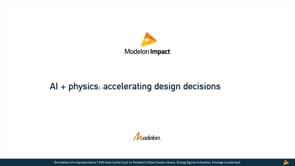
In a live demo, data center engineer Nora asks the AI agent in Modelon Impact, in plain language, how to cut cooling costs without risking uptime. The obvious fix fails a full-day physics check. A ready-made study then runs 24 simulations and finds an 18% saving with no risk, an option few engineers would have tried first. From question to decision took about an hour and a half, instead of days. Watch Nora’s story below.
3. Start from a working system, not a blank sheet
Nora’s study ran on Modelon’s new Data Center Application Package. Application Packages bundle validated component libraries, reference designs, ready-made studies, and AI skills for a specific domain, so engineers start from a working system rather than building a model from scratch. Packages for HVAC and heat pumps, hydrogen and fuel cells, vehicle dynamics, batteries, aircraft thermal management, and thermal power and storage are planned next.
4. The difference between an estimate and a design
Making simulation easier only matters if the answers hold up. To show why, Chief Strategy Officer Johan Andreasson asked an AI agent to size the radiators for a solar-powered AI compute station in orbit. On its own, the agent’s answer changed every time it was asked. Connected to Modelon Impact through the new Modelon AI Connector, it gave the same answer every time, traced to validated models, and caught a design flaw a quick estimate would have missed. Watch the demonstration below.

The AI Connector lets external AI agents use Modelon Impact as their physics engine through the open Model Context Protocol (MCP), and is planned for customer availability in the first half of 2027. It brings simulation to the many engineers who cannot run it today, with answers that are consistent, traceable, and validated.
5. Built for an open, best-of-breed future
As AI agents take over more of the coordination between engineering tools, from requirements and CAD to simulation and manufacturing, teams can rely less on all-in-one suites and choose the best tool for each step. Modelon Impact is built on Modelica, an open modeling standard, and the AI Connector uses the open Model Context Protocol, so validated system simulation fits alongside the tools a team already uses.
What comes next
The message from Stockholm was simple: AI makes simulation accessible, and physics makes it trustworthy. Modelon’s job is to deliver both.
The AI agent in Modelon Impact is available today, and the Data Center Application Package is the first of several domain packages. Modelon Credits, a usage-based way to access AI capabilities in Modelon Impact, are planned for early 2027, with a base level included in standard subscriptions. The Modelon AI Connector is planned for the first half of 2027.
Watch the full Capital Markets Day recording, read the press release, or contact us to see how AI-driven, physics-based simulation could work for your team.