From Simulation to Grid: Demonstrating the Potential of Long-Duration Energy Storage


As more renewable energy comes onto the grid, the hard question isn’t only how to generate clean electricity. It’s how to store that electricity until it’s needed. Long-duration energy storage can make the grid more resilient, support existing transmission and distribution infrastructure, and let a greater share of low-cost, variable renewable energy onto the grid. That question drove Muhammad Mubashar Ashraf’s PhD research at Virginia Tech. Modelon Impact became a critical tool in his work.
How Particle-Based Thermal Energy Storage Works
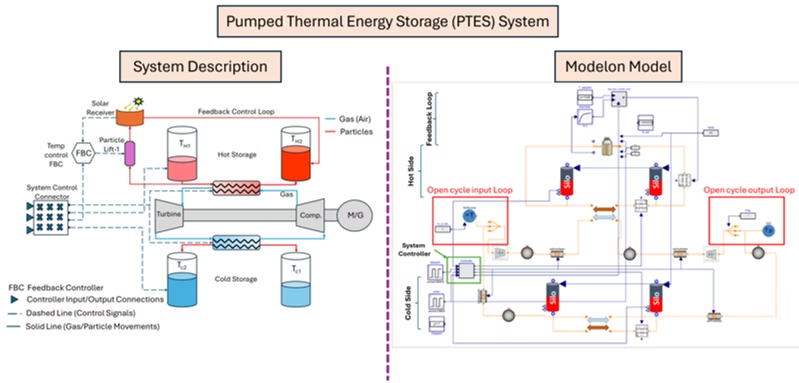
Muhammad’s research focused on long-duration thermal energy storage, which stores surplus electricity as heat and converts it back into power when it’s needed. Through research internships with the National Laboratory of the Rockies (formerly the National Renewable Energy Laboratory), he modeled a pumped thermal energy storage system. His work fed into the lab’s PUMP project, which developed a long-duration storage system built around low-cost particles and a fluidized bed heat exchanger. The system heats silica particles to high temperatures and stores them in thermal silos.
The idea is simple. When electricity is cheap, the system charges by converting electricity into heat. When prices rise, it turns the stored heat back into electricity and sells it to the grid.
Building it was not simple. The project had three layers: modeling the individual components, integrating them into a full system model, and implementing the controls that run the system. The last step was testing how the system would behave once connected to the electrical grid.
Why Modelon Impact Worked for Thermal Energy Storage Modeling
Muhammad started from component models already developed at the NLR lab and used Modelon Impact for all three layers. He pointed to several reasons it made a difference:
- Open standards: Modelon Impact is built on the open-source Modelica language, so he could build directly on the lab’s existing Modelica component models instead of starting from scratch.
- Dynamic, high-fidelity simulation: He could solve a detailed system model over exactly the time periods he needed to study.
- Support when he got stuck: Modelon’s technical support team helped him work through errors and understand what was happening behind the scenes.
- Examples to learn from: Muhammad was new to controls. He studied Modelon’s example system models to learn about the environment, then applied what he learned to his own system.
- Pre-built components: Ready-made library components sped up development.
- FMU export: He exported his system model as an FMU, which kept every system parameter intact for his grid-integration study.
“In other Modelica tools, the biggest challenge is resolving errors, and sometimes you don’t even know where an error is coming from. That’s where Modelon Impact helped. Modelon contributed a lot to my research.” – Muhammad Mubashar Ashraf, PhD
From Detailed Simulation to a Full System Model
Muhammad’s work spanned the full modeling tool chain, and Modelon Impact is where it all came together. He did his initial calculations and parameterization in Engineering Equation Solver (EES) with Excel, and in Cantera with MATLAB. He then built a CFD model of a fluidized bed heat exchanger in Ansys Fluent. This is a complex component, because heated particles and air flow in opposite directions and make direct contact inside it. That direct-contact design is also what makes it promising: it eliminates the heat transfer surfaces between the air and the particles, which dramatically reduces its cost and improves thermal performance. He validated the CFD model against results from the NLR lab’s prototype test station, where testing showed the heat exchanger achieved high heat transfer effectiveness.
He then took key parameters from the testing and CFD work, including the overall heat transfer coefficient, pressure drop, and minimum fluidization velocity. He used them to build a heat exchanger component model in Modelon Impact that reproduced the experimental and CFD results, and that component became part of the full system model.
Results: 52–53% Round Trip Efficiency (RTE) and Profitability Across Six U.S. Regions
The research produced two papers, both now submitted for publication. The first focuses on the technical side. It shows that long-duration systems like this are technically feasible, with a system round-trip efficiency (RTE) of about 52 to 53%, consistent with values reported in literature for the comparable particle-based and pumped thermal energy storage configurations.
The second paper used charge and discharge data from the exported FMU to study grid integration and run a techno-economic analysis across six U.S. regions. The analysis demonstrated that economic performance depends strongly on electricity price spreads, market volatility and system operating characteristics. In favorable markets, the system could charge during periods of low electricity prices and discharge during periods of high demand and elevated prices. This potentially complements conventional peak generation and supports greater renewable energy integration.
The lab’s published technical report points the same way: its cost and performance analyses show the system’s potential economic benefits, and it concludes the technology is promising for future pilot demonstration and scale-up.
What’s Next: From Energy Storage to Data Center Thermal Engineering
Muhammad has completed his PhD defense and now works as a thermal engineer at Vertiv in Greenville, South Carolina. There he designs computer room air conditioning (CRAC) products and other thermal solutions for data center critical infrastructure, contributing at every stage from modeling and design to cooling load calculations, manufacturing, and deployment. His dissertation papers are currently in peer review, and some of his results already appear in the lab’s published technical report on the project.
Muhammad’s project shows what system-level dynamic modeling makes possible: taking a component validated against CFD and lab testing, building it into a full system with controls, and carrying that same model into grid and economic analysis. Modelon Impact kept that chain connected, from the first component model to the FMU behind his techno-economic study and helped him get through a multi-year project faster.
Working on energy storage, thermal systems, or grid integration? Learn more about Modelon Impact to see how dynamic system simulation can speed up your work.