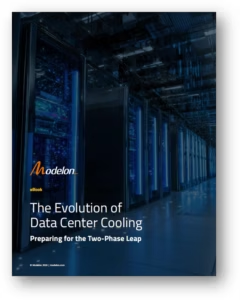
The Evolution of Data Center Cooling: Preparing for the Two-Phase Leap

What happens when the coolant starts to boil just as an AI workload spikes?
Two-phase cooling uses boiling to remove more heat from densely packed chips. That same phase change can trigger rapid pressure and flow shifts or cause cold plate dryout, where liquid coolant loses contact with the heated surface. Those risks matter when you’re deciding how much cooling capacity to build in and how quickly your controls need to respond.
Modelon’s new eBook helps engineers and engineering leaders compare cooling architectures for AI and high-performance computing (HPC) data centers. See how dynamic system simulation lets you evaluate equipment sizing and test control strategies together before committing to hardware.
“Every kilowatt of overprovisioned cooling is capital spent and efficiency lost.”
What You’ll Learn:
- Compare air, single-phase liquid, and two-phase cooling.
See where each approach fits as rack power and chip heat loads rise. - Identify what drives cooling energy use.
In one simulated liquid-cooled facility, pumping accounted for nearly 79% of cooling energy use. See what the study revealed about equipment sizing and part-load controls. - Understand how dryout and pressure instability develop.
Explore how rapid changes in chip load can affect refrigerant flow and cooling performance across the loop. - Design the coolant distribution unit and its controls together.
See how a digital twin can help you test control logic before building hardware and lay the groundwork for predictive control.
Learn more about Modelon’s Solutions for Data Centers.